Ask a dental office administrator what the hardest part of their job is, and you will get a range of answers. The insurance hold times. The last-minute schedule changes. The patient who is furious about a bill that has nothing to do with the office. The provider who needs the day rearranged with twenty minutes’ notice.
But ask a little deeper, and something else often comes up: the feeling of doing it all without anyone nearby who truly understands what it takes.
Dental office administration is, in many ways, an isolating profession. Not because the work is solitary — administrators talk to people all day. But because the specific pressures of the role, the particular combination of skills it demands, and the emotional weight it carries are not things that most colleagues outside the administrative team fully appreciate. You can be surrounded by people and still feel professionally alone.
That is the problem community is designed to solve.
What professional isolation actually costs
When professionals do not have access to a community of peers, a few things tend to happen. Problems that could be solved quickly, because someone else has already solved them, take much longer to work through alone. Frustrations that could be normalised and processed through shared experience instead accumulate. And the sense that your work is valued, which is so often reinforced by the acknowledgement of people who understand it, quietly erodes.
For dental office administrators and managers, this plays out in practical ways. The administrator who has never connected with anyone outside her own office may not know that the insurance challenge she has been struggling with has a straightforward workaround that others have long since figured out. The manager navigating a difficult team dynamic may not realise how common that dynamic is, and how others have handled it with success. The consultant entering a new practice may not have a network of peers to draw on when the situation calls for an outside perspective.
Community does not eliminate these challenges. But it makes them significantly more manageable.
What community looks like at DOMAC
When we talk about community at DOMAC, we mean something practical and ongoing, not a once-a-year event or a directory of names.
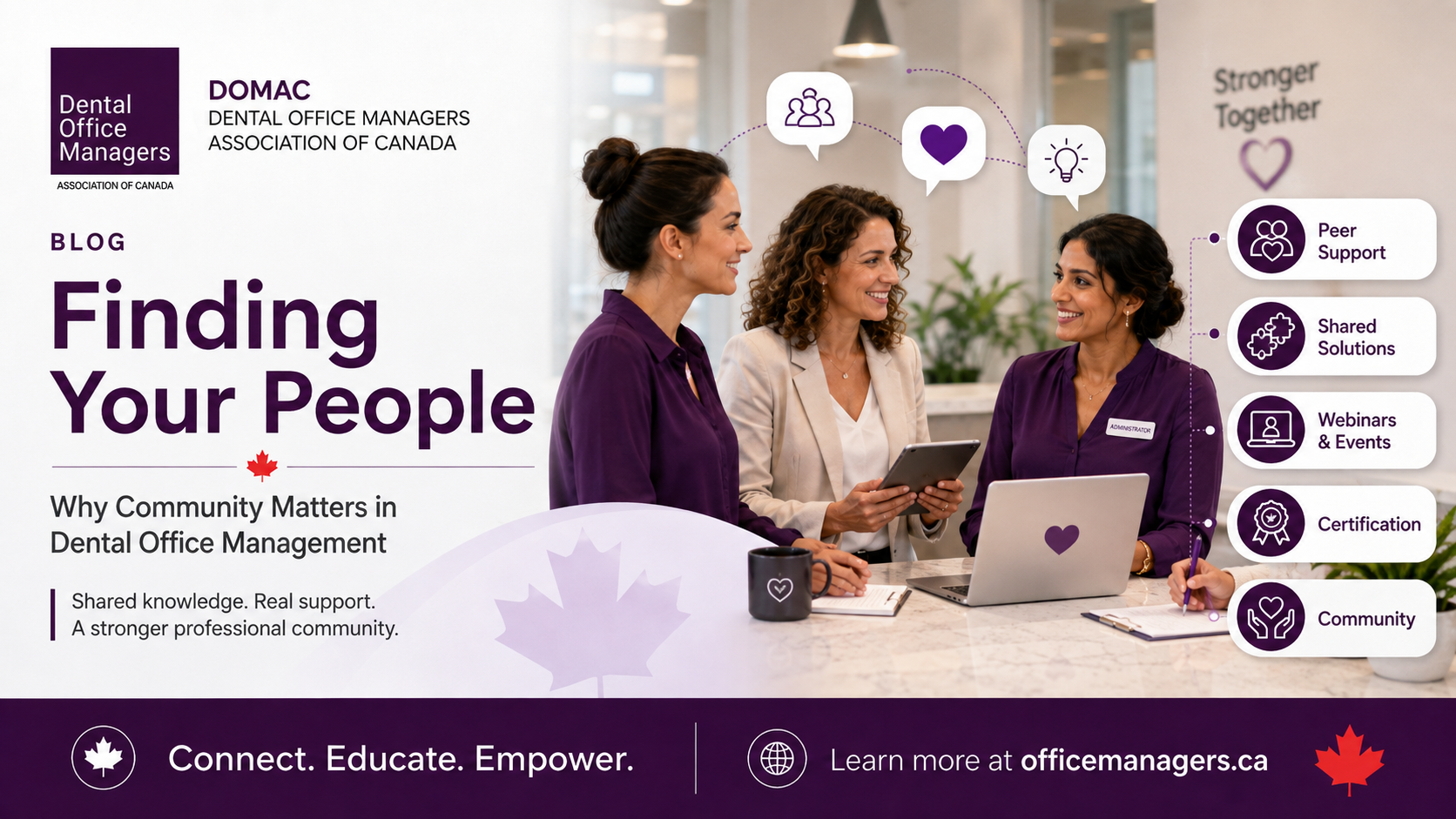
Our national Facebook community brings dental office professionals together in a space where real questions get real answers from people who have been in the same situation. It is a place where you can ask about an insurance issue, share a win, vent about a hard week, or simply connect with someone who gets it.
Our webinars and events are designed to take professionals out of their offices and into a space where learning and connection happen together. And our certification programs create a shared framework — a common language for professional standards — that brings members into a community of practice with recognised standing.
None of this replaces the relationships you build within your own office or your own community. But for many dental office professionals, DOMAC fills a gap that has been there for a long time.
An invitation
If you have been doing this work for years without a professional community around you, I want to be direct: that gap is real, and it has a cost. Not just in the practical sense of missing out on shared knowledge, but in the quieter sense of doing meaningful, skilled work without the professional recognition and peer connection that work deserves.
DOMAC exists to change that. Membership is free. The community is active. And the people in it understand, in a way that most people outside the field do not, exactly what your days look like.
You do not have to do this alone.
Monica Trimble, Executive Director, Dental Office Managers Association of Canada